Goods and Services Tax (GST) has become an integral part of the tax framework in India. For businesses, GST compliance is not limited to filing returns and paying taxes within the prescribed time. It involves maintaining proper records, reporting transactions accurately, claiming eligible Input Tax Credit and ensuring that the information reported in GST returns is consistent with the books of accounts.
For many businesses, GST compliance is often viewed as a routine statutory requirement. However, regular and accurate compliance can play an important role in managing tax risks and maintaining the financial discipline of an organisation.
What Does GST Compliance Involve?
GST compliance covers various activities that a registered taxpayer is required to undertake under the GST law. These include:
- Timely filing of applicable returns
- Payment of tax liabilities
- Issuance of proper tax invoices
- Maintenance of records
- Reconciliation of GST data with the books of accounts
Input Tax Credit is another important area. Businesses should regularly verify their purchase records and reconcile eligible ITC with the relevant GST data.
Differences may arise because of supplier reporting, credit notes, amendments, timing differences or accounting errors. Identifying such differences on a timely basis helps businesses take appropriate corrective action.
Why Is Regular Compliance Important?
One of the primary benefits of maintaining regular GST compliance is the ability to identify errors at an early stage. A small difference in a monthly return may appear insignificant, but if it remains unresolved over several tax periods, it can become difficult to trace and may result in a larger reconciliation issue.
Regular compliance also helps businesses avoid unnecessary interest and late fees arising from delayed tax payments or return filing. More importantly, maintaining proper records and supporting documents makes it easier to explain transactions in the event of a departmental query, scrutiny, audit or investigation.
Another important aspect is Input Tax Credit. Businesses incur GST on various purchases and expenses in the course of their operations. Subject to the conditions and restrictions prescribed under the GST law, eligible ITC can be utilised against output tax liability.
Proper reconciliation and documentation help businesses identify eligible credit while also reducing the risk of claiming credit that may subsequently be disputed.
Reconciliation Is Key
GST compliance should not end with filing the return. Businesses should periodically reconcile their GST returns with their books of accounts.
For outward supplies, the figures reported in the books, GSTR-1 and GSTR-3B should be reviewed for consistency. Similarly, purchase records and ITC should be reconciled with the relevant GST data and the credit actually claimed in GSTR-3B.
Such reconciliation helps identify issues such as:
- Differences in turnover reported in various records
- Missing or incorrectly reported invoices
- Credit notes and debit notes requiring adjustment
- Differences in Input Tax Credit
- Ineligible or restricted ITC
- Tax payments or liabilities requiring further review
Compliance as a Business Practice
As businesses grow, GST compliance becomes increasingly important. Multiple registrations, large transaction volumes, inter-state supplies, credit notes, vendor-related issues and complex transactions can make GST management more challenging.
Businesses should therefore consider GST compliance as part of their overall financial and internal control system rather than treating it as a return-filing exercise.
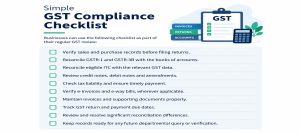
A practical compliance system should include timely return filing, regular reconciliation, proper documentation, monitoring of GST liabilities and periodic review of Input Tax Credit. Where transactions involve complex tax positions, professional advice can also help businesses understand the applicable provisions and maintain appropriate documentation.
Conclusion
GST compliance is not simply about meeting statutory deadlines. It is about ensuring that the tax positions reported by a business are accurate, reconciled and supported by proper records.
A proactive approach to GST compliance can help businesses identify discrepancies early, safeguard eligible Input Tax Credit, minimise avoidable interest and late fees, and remain better prepared for departmental queries or proceedings.
Ultimately, good GST compliance is not only a statutory responsibility but also an important part of responsible business management.